21 hours of SCA teaching. Including a 6 hour masterclass.
Six full sessions. Twenty five cases attempted, marked out loud, then demonstrated properly. Taught by a GP Trainer and programme director of over 20 years.
Secure checkout via Whop. Instant access.
One payment. Lifetime access. 6 videos · 25 cases · Listen anywhere
Why this happens
Why most trainees fail this twice
They do hundreds of practice cases and never change their technique. They use ICE like a tick box. They open with "What can I help you with?" They spend nine minutes on history and rush the management, which is the part carrying the most marks.
Nobody tells them. They just fail again.
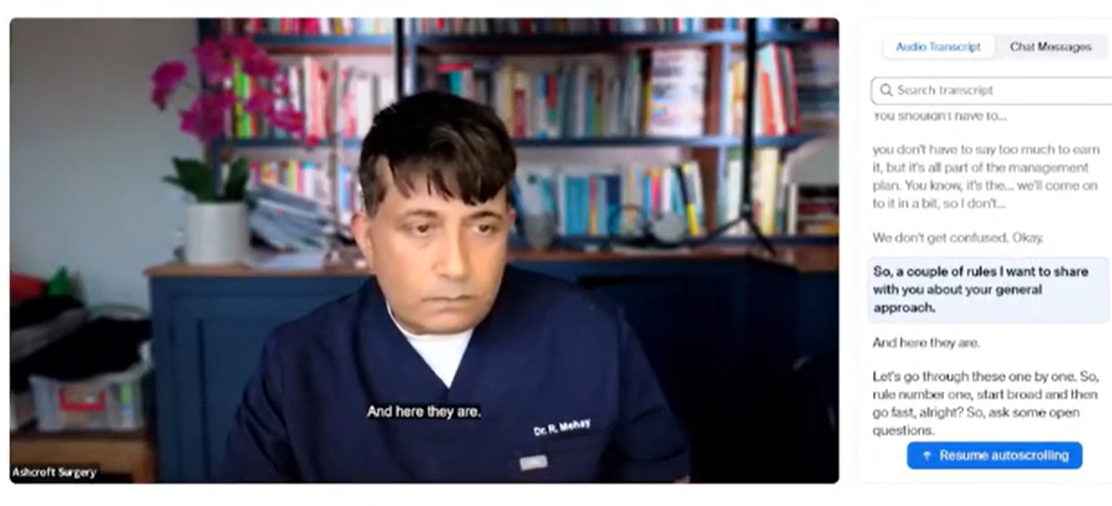
This is 21 hours of that being fixed, live, on real trainees.
What's inside
What's inside
SCA Masterclass
6 hoursSix hours on how to consult, not what to memorise. Making ICE part of a natural conversation instead of a tick box. Grouping your questions by system and signposting as you go, so the history sounds organised rather than scattergun. Actually listening to cues instead of queuing your next question, which is where most missed information goes. Data gathering closed at 6 to 7 minutes, because rushing management is the single most common reason people fail. Realistic NHS plans with shared decision making rather than doctor led over-investigation. And the EDF system for safety netting: Expectation, Deviation from the norm, Follow up. Then eleven cases and drills putting it into practice:
- Three months of headaches in a patient convinced it is brain cancer
- Shortness of breath, and ruling out lung and cardiac causes at speed
- Fuzzy head, odd taste, tingling toe, numb hip, and how not to blame it all on stress
- HIV risk after a recent encounter, in plain explicit language
- A monosyllabic 15 year old with their parent in the room
- Low mood, unemployment, divorce and heavy drinking, structured across three clean areas
- A child with a rare syndrome you have never heard of, and how to admit that well
- COPD exacerbation in a patient too recently bereaved to discuss smoking
- A QRISK of 32% and a patient refusing statins
- Unstable angina and a flat refusal to go to hospital
- Back pain, a sensitive stomach, and no time to exercise
Session 1, Missed Diagnoses
2h 58mWhy the previous clinician's diagnosis is the most dangerous thing in the room. How to use the 6 minute mark to catch the question you forgot to ask, while you still have time to ask it. Why recent onset symptoms should never be pinned on a long standing condition, and how that single habit fails candidates who otherwise consult well.
Session 2, Timing and Explicit Histories
3h 42mStop introducing yourself. There are no marks for names and dates of birth, and the clock is running. Data gathering ends at 7 minutes, because management is worth 4.5 points and data gathering only 3. Maximum two open questions before you start narrowing. And how to take a sexually explicit history in exactly the same tone you would take a cardiac one, because the moment you look embarrassed, the patient stops talking.
Session 3, Difficult Consultations
2h 20mWhy "I'm sorry to hear that" irritates examiners, and what to say instead. Empathy that scores is empathy that changes your management plan, not empathy that sits there sounding kind. Why there is no single rule for the angry patient: sometimes you adapt completely, sometimes you find middle ground, sometimes you hold firm, and knowing which is the skill being tested.
Session 4, Jargon, Rapport and Ethics
2h 53mNever say "wear and tear" again. Why that phrase makes patients worse and how to reframe it so they leave willing to exercise. Why handing over a leaflet or naming a slimming service is a management shortcut that costs you marks. How to switch registers when the patient is a colleague, and why softening a hard contraindication into "I would advise you not to" reads as weakness.
Session 5, Hidden Agendas
3h 35mChange one word in your opening and patients tell you different things. "What would you like to talk about today" opens doors that "What can I help you with" keeps shut, particularly around abuse and shame. How to run a helical consultation where each question comes from the last answer, rather than working down a mental checklist. And why parking a sensitive disclosure to come back to later is the fastest way to lose the patient entirely.
Learn on the move
Learn on the move
This is teaching, not slides. Almost all of it works as audio, so you don't have to be sat at a desk to get value from it.
Put it on during the commute. In the car. At the gym. Cooking, cleaning, walking the dog. Twenty one hours sounds like a lot until you realise it's about two weeks of driving to work.
Most trainees find they take in more this way than they do staring at a screen at 11pm after a full clinic. You hear a case, you hear it marked, you hear it done properly, and the phrasing starts sticking without you forcing it.
Before you ask
Before you ask
- "I've already done loads of practice cases."
- That is probably the problem. Volume without feedback just embeds the same habits.
- "I've failed before."
- Most of the trainees who passed after reviewing these videos were on attempt three or four.
- "I don't have 21 hours."
- You do, you just aren't sat down for them. Listen on the commute, at the gym, doing the washing up. It works as audio.
- "Is this just theory?"
- No. Every case is a live consultation, marked out loud, then run again properly so you can hear the difference.
Pricing
£55. Everything. Forever.
21 hours, 25 cases, no subscription, no expiry. Pay once and it is yours.
Watch on any device. Rewatch as many times as you like.